Background Check in Kern County CA delivers fast, accurate records that meet the needs of employers, landlords, and individuals seeking reliable personal background check online. When you request a Kern County background check, the system pulls from public records, court filings, and law enforcement databases to create a comprehensive background history search. This includes a background check by name, by date of birth, by address, and even by state or county, ensuring that the search results match the exact identity you need. Users often look for Kern County background check records to verify criminal records, driving records, or property ownership, and the service provides a clear background check lookup that cuts through duplicate or outdated information. By focusing on precise data retrieval, the platform helps you avoid common pitfalls such as mismatched identity records or incomplete background records search, giving you confidence in every decision that relies on verified background information.
Background Check services also support a thorough background screening process that covers everything from personal background check online to detailed background history lookup. Whether you need a background check by date of birth, by address, or a full background check records search, the tool offers an easy-to-navigate interface for quick background check by county search. It aggregates background check records, background records lookup, and identity record search into one reliable source, helping you confirm criminal charges, court case dispositions, and even professional licenses. This level of detail satisfies the legal requirements for employment screening, tenant screening, and personal safety, while respecting privacy rules and consumer reporting restrictions.
How to Search Kern County Background Records
A Kern County background check lookup starts when you collect identifying details such as a full legal name, date of birth, and the last known city or ZIP code. The kern county Superior Court and the Kern County Sheriff’s Office maintain separate databases, so a complete search often requires checking both sources along with the California Department of Justice. Public records in Kern County cover criminal cases, civil filings, and life events stored with the Kern County Clerk’s office. You can use online portals, walk-in requests, or mail-in forms to retrieve these documents.
Official Search Portal: https://www.kerncounty.com/community/contact-us
Steps to Search
- Visit the Kern County official website and locate the public records or community contact page.
- Identify the record type you need, such as criminal, civil, or court records, before submitting a request.
- Provide the subject’s full name, date of birth, and county of residence to narrow the search.
- Submit your request online, in person at the Kern County Clerk’s office, or by mail.
- Pay the required fee and wait for the agency to mail or email your certified record copy.
Search by Full Name
A full name search pulls every record linked to that exact string of first, middle, and last name within Kern County court and police databases. If the subject uses multiple name variations, such as a maiden name or nickname, you must run each spelling separately to catch every match. Many Kern County arrest logs and case dockets use the legal name on file at booking, so a small spelling difference can hide records. To improve accuracy, pair the name with a date of birth or address.
Search by Date of Birth
Using a date of birth narrows your background check results down to one specific person, even when many people share the same name. Kern County courts store date of birth in their case management system and most public docket searches let you input this field. The California Department of Justice also accepts date of birth as a required filter when requesting statewide rap sheets. Always confirm the date matches the subject’s government ID to avoid pulling the wrong file.
Search by Location
Searching by location, such as a city or ZIP code, helps you find records when you only know where the person lived or worked. Kern County covers Bakersfield, Ridgecrest, Delano, Tehachapi, and many smaller communities, so location data ties a person to a specific court jurisdiction. Most online docket tools let you filter cases by court location, which limits results to cases filed in that region. This filter works well for property records, where an address search returns deeds, liens, and tax records tied to that parcel.
Search by State or County
State and county-level searches matter because criminal cases get filed where the offense took place, not where the person lives today. If you only need Kern County records, the Kern County Superior Court portal gives you local case access without state-level fees. For broader coverage, the California Department of Justice runs statewide criminal history checks through the Live Scan system. Out-of-state cases show up only when the subject has lived in another state or committed crimes outside California.
Information Needed for a Background Check
Before starting any background check, gather the subject’s full legal name, any known aliases, date of birth, and last known address. Some Kern County agencies also ask for a driver’s license number or Social Security number for identity verification, though public portals do not. A signed consent form is required when an employer or landlord runs the check, in line with the federal Fair Credit Reporting Act. The more identifiers you provide, the fewer false matches you will see in the final report.
Information Found in a Background Check
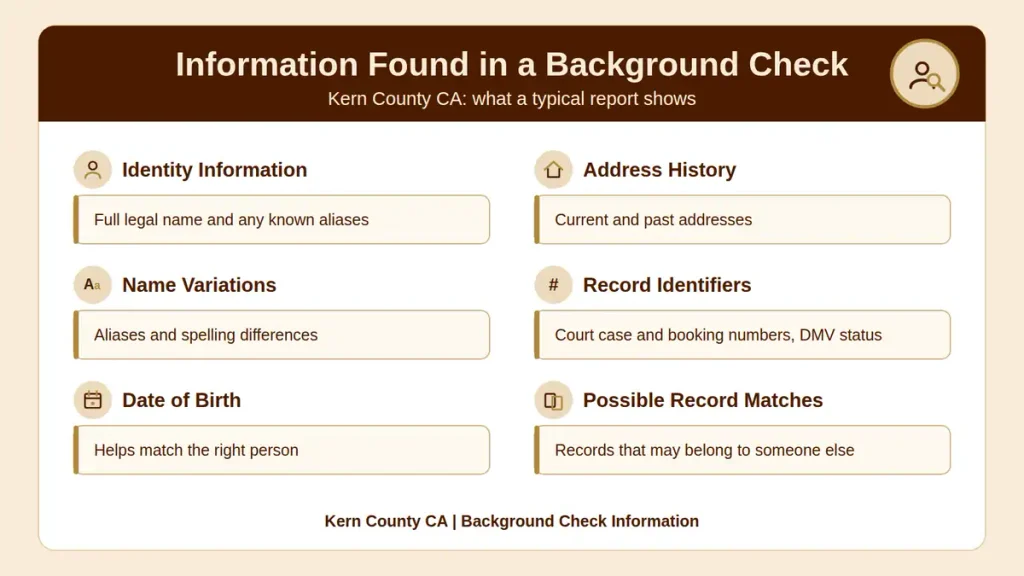
A standard background check report lists identity details alongside every record linked to that person in public databases. Kern County reports often show case numbers, filing dates, and the court that handled each matter. Knowing what to expect helps you read each section without confusing unrelated records with your subject. The list below shows the typical data points you will see in a Kern County background check.
- Full legal name and any known aliases
- Date of birth and current address
- Case numbers from Kern County Superior Court
- Booking numbers from the Kern County Sheriff
- Driver’s license status from the California DMV
Identity Information
The identity section confirms the subject’s full legal name, date of birth, sex, and race as recorded in official records. This data comes from government sources such as the California Department of Motor Vehicles or the Social Security Administration. When identity details do not match the subject’s current ID, the report may flag the record for review. Always read this section first, as every later entry depends on these identity anchors.
Name Variations
Name variations list every alias, maiden name, or nickname that the subject has used in court filings or booking photos. Kern County courts index each alias so that older cases surface during a new search. This section helps you spot records filed under a previous name after marriage or adoption. Reviewing name variations prevents missing a case that was filed under a former legal identity.
Date of Birth
The date of birth line appears on every court record and most police files in Kern County. It serves as a second identifier alongside the legal name to confirm the right person. When two people share a name, the date of birth line removes confusion and points to the correct file. Always cross-check this date with a government ID before relying on the report.
Address History
Address history shows the past addresses tied to the subject through property deeds, court filings, and DMV records. Kern County property records often list multiple years of ownership for each parcel. Reviewing address history helps you verify the subject lived in the jurisdiction where the case was filed. It aids in spotting cases that occurred while the subject lived in another county.
Record Identifiers
Record identifiers include case numbers, docket IDs, booking numbers, and arrest report numbers tied to each event. Kern County courts assign a unique case number at filing, which never changes for the life of the case. These IDs let you pull the certified record copy directly from the clerk’s office. Save these numbers to speed up any appeal or correction request.
Possible Record Matches
The possible matches section lists records that share at least one identifier, such as a name or date of birth. Each match carries a likelihood score so you can decide which entry needs deeper review. Common matches include people with identical names or close birth dates in nearby counties. Treat this section as a starting point and verify each entry before relying on it for employment or housing decisions.
Criminal Records Check
Criminal records form the core of most background checks and usually draw from county, state, and federal sources. Kern County criminal files sit with the Kern County Sheriff’s Office, the Bakersfield Police Department, and the Kern County Superior Court. A criminal section shows the arrest, charges filed, court outcomes, and any sentencing details. Review each subsection below to see what your report lists.
Arrest Records
An arrest record shows the date, location, and agency that took the subject into custody, along with the arresting officer’s name. Kern County arrest data comes from the Kern County Sheriff’s Office and the Bakersfield Police Department. An arrest alone does not prove guilt, so courts treat it as a separate data point from a conviction. Always pair an arrest record with the case disposition to see what happened later in court.
Criminal Charges
Criminal charges list the statute or code section that the prosecutor filed against the subject, such as Penal Code 211 for robbery. Kern County prosecutors file charges through the Kern County District Attorney’s Office, which then sends the case to Superior Court. Each charge carries a classification, such as felony, misdemeanor, or infraction. Charge details help you understand the severity of the case and any sentencing that may follow.
Misdemeanor Records
Misdemeanor records cover less serious offenses, such as simple assault, petty theft, or driving under the influence with no injury. Kern County courts handle misdemeanors in the limited-jurisdiction divisions of the Superior Court. These cases carry a maximum sentence of one year in county jail, plus fines. Most misdemeanor cases resolve within a year of arrest, so older files may show the sentence served or dismissed.
Felony Records
Felony records cover the most serious offenses, such as murder, rape, or major drug trafficking cases. Kern County Superior Court handles felonies, with serious cases assigned to specific felony departments. A felony conviction can lead to state prison time and longer parole periods. These cases often appear on background checks for years because felonies are not eligible for automatic expungement in many cases.
Conviction Records
Conviction records show the final outcome of a criminal case after a plea or trial verdict. Kern County courts enter convictions only after the judge accepts a guilty plea or the jury returns a guilty verdict. A conviction stays on the record unless it gets expunged, sealed, or pardoned. Employers and landlords often weigh convictions more heavily than arrests.
Criminal Case Dispositions
Case dispositions show the final ruling in each criminal file, such as guilty, not guilty, dismissed, or diverted. This data comes from the Kern County Superior Court after the judge signs the final order. Reviewing dispositions helps you separate dismissed cases from active convictions. Always read this section to avoid mistaking a dismissed charge for a conviction.
Court Records
Court records add depth to a background check by showing every case filed in Kern County courts. The Kern County Superior Court handles criminal, civil, family, probate, and small claims matters under one roof. Each case carries a docket, a case number, and a list of hearings and orders. The next subsections break down what each type of court record contributes to your report.
Criminal Court Cases
Criminal court cases track every hearing, plea, and sentence in a felony or misdemeanor file. Kern County court records list the charges, attorneys, judge, and final disposition in the official docket. You can view most criminal dockets online through the Kern County Superior Court portal. Older files may require a mail request or an in-person visit to the clerk’s office for a certified copy.
Civil Court Cases
Civil court cases cover disputes between people or businesses, such as contract issues, personal injury claims, or property conflicts. Kern County civil dockets show the plaintiff, defendant, attorney, and judgment amount. Civil judgments can affect credit reports and appear on background checks for up to ten years. Review civil cases to spot unpaid judgments or recent lawsuits tied to the subject.
Case Filings
Case filings record the initial paperwork that started each court case, such as complaints, petitions, or criminal complaints. Each filing carries a date and a filing party, and it sits at the top of the official docket. Kern County courts accept filings in person, by e-file, or by mail depending on the case type. Filings mark the official start of the matter and help you track case timelines.
Court Hearings
Court hearings list every scheduled event in a case, such as arraignments, pre-trial motions, trials, and sentencing. Kern County courts post hearing dates on the public docket after the clerk schedules them. Each hearing entry shows the date, time, courtroom, and the judge assigned to the matter. Tracking hearings helps you see how a case moved through the system.
Court Orders and Outcomes
Court orders and resolutions show the final decisions a judge made, such as a sentencing order, a restraining order, or a judgment in a civil case. Kern County courts issue signed orders that the clerk files and stores. These orders carry the weight of law and often shape the final report entry. Always request a certified copy when you need to use the order in another legal proceeding.
Kern County Court Record Sources
Kern County court records come from the Kern County Superior Court Clerk’s office, located at 1415 Truxtun Avenue in Bakersfield. You can search dockets online, request copies by mail, or visit the clerk’s office in person during business hours. Each source charges a small fee for copies, which the court sets by California law. The clerk’s office follows the same hours as other Kern County departments.
Other Records That May Appear
A thorough Kern County background check pulls in many record categories beyond criminal and court files. Property, business, driving, marriage, and bankruptcy records all sit in public databases maintained by county and state agencies. The next subsections describe each record type and what details it adds to the final report.
Property Records
Property records show real estate owned by the subject in Kern County, such as houses, condos, or vacant land. The Kern County Assessor-Recorder maintains these files and offers an online parcel search. Each record lists the owner’s name, parcel number, assessed value, and deed history. Property records help landlords verify ownership before signing a lease.
Business Records
Business records cover any company the subject owns or manages, filed with the California Secretary of State. These filings show the business name, registration number, status, and agent for service of process. Kern County residents often register small businesses through the Secretary of State, not the county. Searching business records helps you confirm self-employment claims on a resume.
Professional Records
Professional records list any state license held by the subject, such as a nursing license, contractor license, or real estate license. The California Department of Consumer Affairs runs the main license lookup for these professions. Kern County professionals renew through the state board, not the county. Verifying a license protects employers from hiring unlicensed workers.
Driving Records
Driving records show the subject’s license status, points, accidents, and DUI convictions. The California Department of Motor Vehicles issues these records through an authorized requester or the subject’s own MyDMV account. Kern County residents often need driving records for insurance or employment purposes. Driving history stays on file for several years and affects insurance premiums.
Marriage and Divorce Records
Marriage and divorce records show life events tied to the subject, filed with the Kern County Clerk-Recorder. These records list the spouse’s name, marriage date, and divorce decree details. Certified copies are available only to eligible requesters under California law. These records help verify name changes after marriage.
Bankruptcy Records
Bankruptcy records cover any Chapter 7 or Chapter 13 filings made by the subject in federal court. The U.S. Bankruptcy Court for the Eastern District of California handles Kern County cases, sitting in either Fresno or Bakersfield. Each filing lists the debtor’s address, assets, and discharge date. Bankruptcy data stays on the credit report for up to ten years.
Status of Records Found
The status section of a background check tells you where each case sits in the legal process. Kern County courts mark cases as active, pending, closed, dismissed, historical, or sealed. Knowing the status helps you decide how much weight to give each record. The next subsections explain each status and what it means.
Active Records
Active records show cases still moving through the court system, with future hearings or pending motions. Kern County courts list active cases in the public docket with the next hearing date. An active criminal case may not have a final outcome yet, so treat the entry as preliminary. Review the active flag before relying on the data for employment or housing decisions.
Pending Cases
Pending cases describe matters that have been filed but not yet resolved by a judge or jury. These entries show the filing date, the next court date, and the parties involved. Kern County pending cases appear on the docket with a status code that says “pending” or “under advisement.” Always recheck pending entries before making a decision.
Closed Cases
Closed cases show files where the court has issued a final order and no further action is planned. Kern County courts close a case after sentencing, dismissal, or judgment. A closed case carries the final disposition in the official record. Closed cases still appear on background checks because the file stays in the public database.
Dismissed Cases
Dismissed cases describe matters the court dropped before a final verdict, often due to lack of evidence or a plea deal. The Kern County District Attorney’s Office can request dismissal by reviewing official bankruptcy online records, or a judge can dismiss on their own motion. A dismissal stays on the record but shows the case ended without a conviction. Most employers treat dismissed cases as resolved in the subject’s favor.
Historical Records
Historical records cover cases that closed years ago and now sit in long-term storage. Kern County archives old files at the Superior Court Records Center. Historical cases still appear on background checks but may require a special retrieval fee. Review historical entries for full context, as the subject may have completed sentencing long ago.
Sealed or Expunged Records
Sealed or expunged records describe cases a judge ordered hidden from public view. Under California Penal Code 1203.4, a Kern County judge can expunge certain convictions after the subject completes probation. Sealed records do not appear on most background checks, but police agencies and certain government departments can still see them. Expungement does not erase the record but limits public access.
Verifying Background Matches
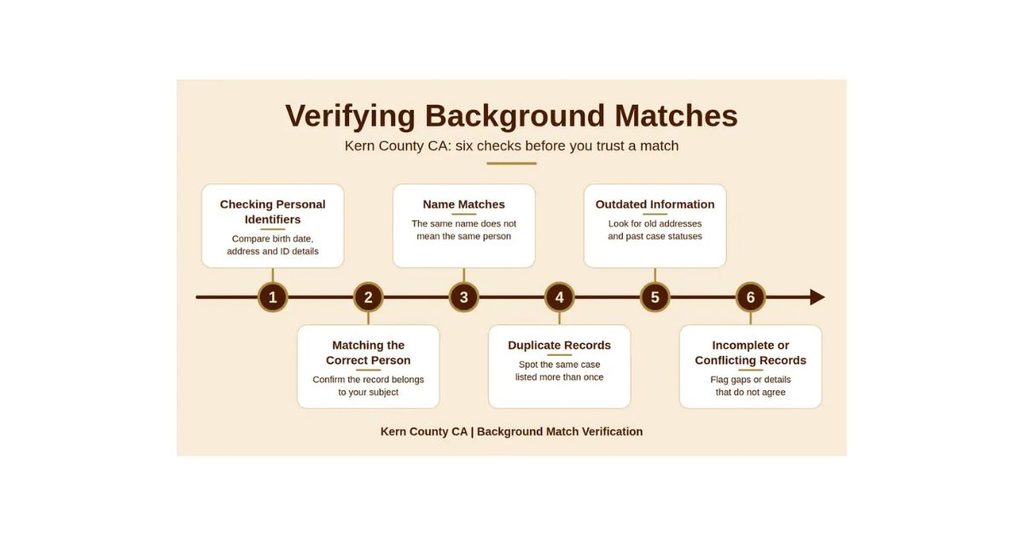
Verification is the process of confirming each record in a background check points to the right person. Kern County databases sometimes show several people with the same name or close birth dates. You must review personal identifiers to confirm the report belongs to your subject. The next subsections walk through how to verify each match.
Checking Personal Identifiers
Personal identifiers include the subject’s full name, date of birth, Social Security number, and driver’s license number. Compare these data points with government-issued ID to confirm a match. Kern County courts store these identifiers in the case header for every file. A single mismatch should trigger a deeper review before you accept the record.
Matching the Correct Person
Matching the correct person requires more than a shared name. Cross-check the date of birth, address history, and known relatives in the case file. Kern County dockets often list family members as witnesses or co-parties. Use these data points to confirm the file points to your subject.
Name Matches
Common name matches appear when several people in Kern County hold identical legal names. Junior and senior naming conventions, hyphenated surnames, and popular first names all create these matches. Use the date of birth and address history to filter them. A score sheet from the background check provider can also rank matches by likelihood.
Duplicate Records
Duplicate records happen when the same case shows up twice under different case numbers or agencies. Kern County courts sometimes merge duplicate files after the clerk notices the error. A duplicate record still counts as one case in your final tally. Review the case history to spot merged entries before you finalize your report.
Outdated Information
Outdated information describes records that show old addresses, former spouses, or past employers that the subject no longer has. Kern County records reflect data at the time of filing, so they may lag behind recent changes. Recheck address history and license records against current ID before relying on them. Outdated data can mislead a hiring decision if left unchecked.
Incomplete or Conflicting Records
Incomplete or conflicting records describe files missing key data or showing conflicting facts between agencies. Kern County courts occasionally have mismatched birth dates or partial addresses in older files. A conflicting record needs a manual review at the clerk’s office or a certified copy request. Always resolve conflicts before using the report for any official purpose.
Check Limitations
No background check covers every record on a person, and Kern County data has gaps like any other jurisdiction. Knowing the limits of your search prevents bad decisions based on missing data. The next subsections outline the most common gaps and how they affect the final report.
Restricted and Confidential Records
Restricted and confidential records cover files that state or federal law hides from public view. Examples include juvenile cases, sealed adoption files, and certain mental health commitments. Kern County agencies withhold them even from most employers. They appear on a background check only when the subject gives written consent or a court orders disclosure.
Juvenile Records
Juvenile records describe cases where the subject was under 18 at the time of the offense. California Welfare and Rules of Court limit public access to most juvenile files. Kern County Juvenile Court handles these cases and seals most records after the subject turns 18. Juvenile records rarely appear on background checks.
Sealed and Expunged Records
Sealed and expunged records do not appear on most background reports. The court order removes the file from the public docket and limits access to police agencies. Kern County courts seal records only after the subject meets all legal conditions. Always verify expungement status with the court before assuming a record has been hidden.
Records Missing From Certain Jurisdictions
Records missing from certain jurisdictions appear when a case was filed in another county or state. Kern County searches do not reach Tulare, Los Angeles, or federal cases unless you run them separately. A complete background check adds statewide and federal database searches. Without them, you risk missing serious offenses filed elsewhere.
Reporting Delays
Reporting delays describe the time between an event and its appearance in the public database. Kern County clerks often take days or months to log a new case in the online docket. Driving records from the DMV can take weeks to update after a citation. Always run a second search after a few weeks if you need the freshest data.
Limits of Name-Based Searches
Name-based searches miss records when the subject used a different spelling, alias, or maiden name. Kern County courts do not auto-link aliases, so each spelling needs its own search. Pair the name with a date of birth and address to catch missing cases. A name-only search works for unique names but fails for common ones.
Public Records and Official Records
Public records cover any document open under the California Public Records Act, while official records carry a court seal or government certification. Kern County courts issue official records for a certified copy fee. Public records give you a snapshot, but official records carry legal weight in court or for immigration filings.
Privacy and Legal Considerations
Privacy laws shape how you can collect, use, and store background check data in Kern County. Federal rules under the Fair Credit Reporting Act (FCRA) and California rules under the California Investigative Consumer Reporting Agencies Act (ICRAA) both apply. The list below shows common lawful uses for background data.
- Employment hiring and promotion decisions
- Tenant screening on rental properties
- Volunteer screening at schools and youth programs
- Licensed professional verification
- Personal safety checks with written consent
Lawful Use of Background Information
Lawful use means you only run a background check for a purpose allowed under federal and state law. Permissible purposes include employment decisions, tenancy screening, and volunteer screening. The FCRA lists these purposes and bans the use of reports for unrelated decisions, such as social media stalking. Stay within these rules to avoid fines and lawsuits.
Personal Information Protection
Personal information protection requires you to store background check results in a secure system with limited access. The California Consumer Privacy Act (CCPA) gives California residents the right to request their data and ask for deletion. You must honor deletion requests within 45 days and verify the requester’s identity. Use encryption and access logs to protect stored data.
Employment Screening Requirements
Employment screening requirements include getting written consent before running a background check on a job applicant. The FCRA also requires you to give the applicant a copy of the report and an adverse action notice if you reject them based on the data. Kern County employers must follow the California Fair Employment and Housing Act (FEHA), which adds extra protections. Stay current with both federal and state rules.
Consent Requirements
Consent requirements mean the subject must sign a written release before you run the check. The release should list the type of records you will pull, the purpose of the search, and who will receive the report. Kern County landlords and employers both need signed consent before accessing most records. A verbal agreement does not meet the legal standard.
Consumer Reporting Restrictions
Consumer reporting restrictions limit how long you can keep certain records on a background report. Under the FCRA, most non-conviction data must drop off after seven years. Convictions can stay on a report indefinitely. California ICRAA imposes shorter time limits on certain data, such as paid tax liens.
Record Correction Rights
Record correction rights give the subject the right to dispute inaccurate data on a background report. Under the FCRA, the consumer reporting agency must investigate disputes within 30 days. The Kern County Superior Court also lets you file a motion to correct clerical errors in court records. Always give the subject a copy of the report and explain the dispute process.
Verifying Background Information
Verification turns a background report into reliable data by confirming each entry with the agency that issued it. Kern County agencies accept requests for criminal, court, driving, and professional records through their own portals. The next subsections outline the steps for verifying each record type.
Requesting Criminal Records
Requesting criminal records starts with the Kern County Sheriff’s Office or the California Department of Justice through the Live Scan system. The DOJ runs statewide criminal history checks for a set fee. Kern County agencies provide arrest logs and incident reports on a per-request basis. Always pair the criminal record with the court disposition for the full picture.
Requesting Court Records
Requesting court records involves contacting the Kern County Superior Court Clerk’s office at 1415 Truxtun Avenue in Bakersfield. You can view dockets online, request copies by mail, or visit the clerk in person during business hours. Certified copies carry a small fee set by state rule. The clerk’s office follows standard Kern County business hours.
Requesting Driving Records
Requesting driving records goes through the California Department of Motor Vehicles, either online through the MyDMV portal or by mail using form INF 1125. Kern County residents often need driving records for insurance or employment purposes. The DMV charges a small fee for each record. Authorized requesters such as employers can also run driving record checks with consent.
Requesting Professional Records
Requesting professional records involves looking up the subject’s license through the California Department of Consumer Affairs license search. This database lists nurses, contractors, pharmacists, and many other licensed workers. Kern County residents renew through the state board, not the county. Always check the license status before hiring someone for a licensed role.
Certified Record Copies
Certified record copies carry the court seal or agency stamp, proving the document is authentic. Kern County courts issue certified copies of judgments, orders, and certain case files. The clerk charges a fee per page and per certification. You need certified copies for any legal filing that requires proof of the record.
Official Record Verification
Official record verification means contacting the issuing agency to confirm the report matches their files. Kern County agencies confirm records only with proper identification and through available police blotter portal resources, in some cases, a signed release. The clerk’s office can confirm court records while the DOJ confirms criminal history. Always keep a paper trail of your verification request.
Background Check Search Problems
Background checks do not always go smoothly, and Kern County searches face the same common pitfalls as searches in other counties. Knowing these pitfalls ahead of time saves you from bad decisions. The list below shows the most frequent issues and how they point them.
- Empty results from a misspelled name
- Too many records sharing the same identity
- Outdated addresses and old employer data
- Restricted files hidden by court order
- Conflicting data between agencies
No Records Found
No records found means the search returned an empty result, often because the subject has no Kern County file or because the spelling did not match. Try alternate name spellings, a different date of birth, or a wider date range. A clean Kern County result does not mean a clean statewide result, so expand your search.
Too Many Matching Records
Too many matching records show up when the name is common in Kern County. Add a date of birth, middle name, or address to narrow the list. A clear identification filter can cut a list from dozens down to one or two entries. Always confirm each match before relying on the data.
Incorrect Person Match
An incorrect person match happens when the search pulled a record for someone else who shares a name. Cross-check identifiers such as date of birth, address, and relatives listed in the case file. Pulling a certified copy from the clerk’s office confirms the match. Never rely on a name match alone.
Missing Records
Missing records describe cases filed in another county or state that did not appear in your Kern County search. A statewide or nationwide search can fill the gap. Federal cases filed in the Eastern District of California also need a federal search. Combine all sources for a complete report.
Outdated Records
Outdated records show old addresses or old case data that no longer applies. Recheck the subject’s current ID and run a fresh search to confirm the report is current. Old data may still matter for some decisions, but confirm it before relying on it.
Restricted Records
Restricted records do not appear on most background checks because state or federal law hides them. Sealed cases, expunged convictions, and juvenile records fall into this category. A restricted record does not mean the subject has no history. It means the public report does not list it.
Conflicting Information
Conflicting information appears when different agencies list different data for the same subject. A court might list a different birth date than the DMV. Resolve conflicts by contacting each agency directly and pulling certified copies. Document the final source for each data point.
Contact Information
For Kern County background check questions or record requests, use the official contact details below. These channels come from the Kern County community contact page. Always call ahead to confirm hours and fees before visiting in person. For online inquiries, visit the Kern County community contact page using the URL listed in the table above. The page lists phone numbers for each department and links to public record request forms.
Frequently Asked Questions
Background checks help employers, landlords, and individuals verify identity, criminal history, and public records. Accessing Kern County background check data quickly reduces risk and supports informed decisions. Below are common questions and clear steps to obtain accurate results.
How can I run a Kern County background check by name?
Start by gathering the full legal name, date of birth, and last known address. Visit the Kern County Superior Court website and use the online case search tool. Enter the name exactly as recorded. Next, check the Kern County Sheriff’s Office inmate lookup for any recent arrests. Finally, request a statewide report from the California Department of Justice for a complete picture. Each source may charge a small fee, but together they deliver a thorough background record.
What records are included in a Kern County CA background check?
A Kern County background check pulls criminal filings, civil lawsuits, traffic citations, and court judgments. It also shows probation status, parole information, and any sealed or expunged cases that remain visible to law enforcement. For property owners, the search reveals liens, foreclosures, and tax delinquency. Combining county and state databases ensures no major detail is missed.
Can I search Kern County background records using a date of birth?
Yes. Input the exact birth date into the Kern County Sheriff’s online inmate search. The system matches the date with any arrest or booking records. Pair this with the county court’s docket search, selecting the “date of birth” filter if available. Adding the ZIP code narrows results and reduces false matches. This approach works well for verifying identity when names are common.
How do I obtain public background information for a Kern County resident?
Public records are accessible through the Kern County Recorder’s Office and the public portal on the county website. Request birth, marriage, or death certificates by completing the online form and paying the statutory fee. For criminal history, use the sheriff’s inmate lookup or the state DOJ request form. All requests require a valid reason and may need proof of identity.
What are the steps to perform a Kern County lookup online?
First, collect the person’s full name, DOB, and address. Second, search the Kern County Superior Court docket for civil and criminal cases. Third, check the Kern County Sheriff’s inmate database for recent arrests. Fourth, submit a request to the California DOJ for a statewide criminal history report. Finally, compile the findings, verify dates, and store the documents securely. Following these steps yields a reliable background report.